IB PYP ATL Skills help students develop essential lifelong learning abilities such as thinking, communication, research, self-management, and social skills. In the Primary Years Programme (PYP), these Approaches to Learning skills support inquiry-based learning, student agency, and conceptual understanding across all subject areas.
What Are IB PYP ATL Skills?
Approaches to Learning (ATL) skills are a core element of the IB PYP framework and provide students with the tools they need to become successful learners both in school and beyond. These transferable skills help learners learn how to learn, empowering them to ask questions, solve problems, collaborate effectively, manage their learning, and reflect on their growth. In today’s rapidly changing world, ATL skills are essential for developing independent, confident, and lifelong learners who can adapt to new challenges and contribute meaningfully to their communities.
Within the PYP, ATL skills are intentionally embedded across all Units of Inquiry and subject areas, ensuring that students develop not only knowledge and conceptual understanding but also the skills needed to apply their learning in authentic and meaningful contexts.
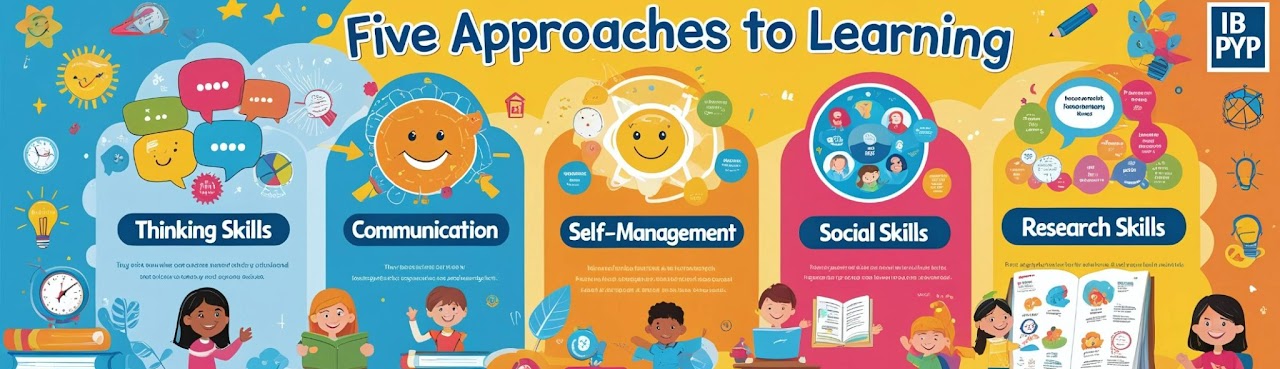
ATL skills are categorized into five key areas:
- Thinking Skills
- Communication Skills
- Social Skills
- Self-Management Skills
- Research Skills
1. Thinking Skills
Importance: These skills enable students to approach complex problems with innovative solutions and reflective thinking. They are crucial for developing independent, lifelong learners who can adapt to various challenges
| Sub-skill | What it can involve | Observable learner behaviour |
|---|---|---|
| Critical thinking | Examining information, identifying relationships, comparing ideas, questioning assumptions, analysing evidence, making reasoned judgements | I can compare information, identify evidence, and explain why I agree or disagree with an idea. |
| Creative thinking | Generating possibilities, making connections, imagining alternatives, designing solutions, looking at ideas from different angles | I can generate more than one possible solution and explain how my ideas are different. |
| Transfer | Applying knowledge, concepts, strategies or skills learned in one context to a new situation | I can use something I learned in one situation to help me solve a new problem. |
| Reflection and metacognition | Thinking about how learning happened, which strategies were effective, what was challenging, what could change next time | I can identify the strategy I used, explain whether it helped, and choose a next step. |
Implementation S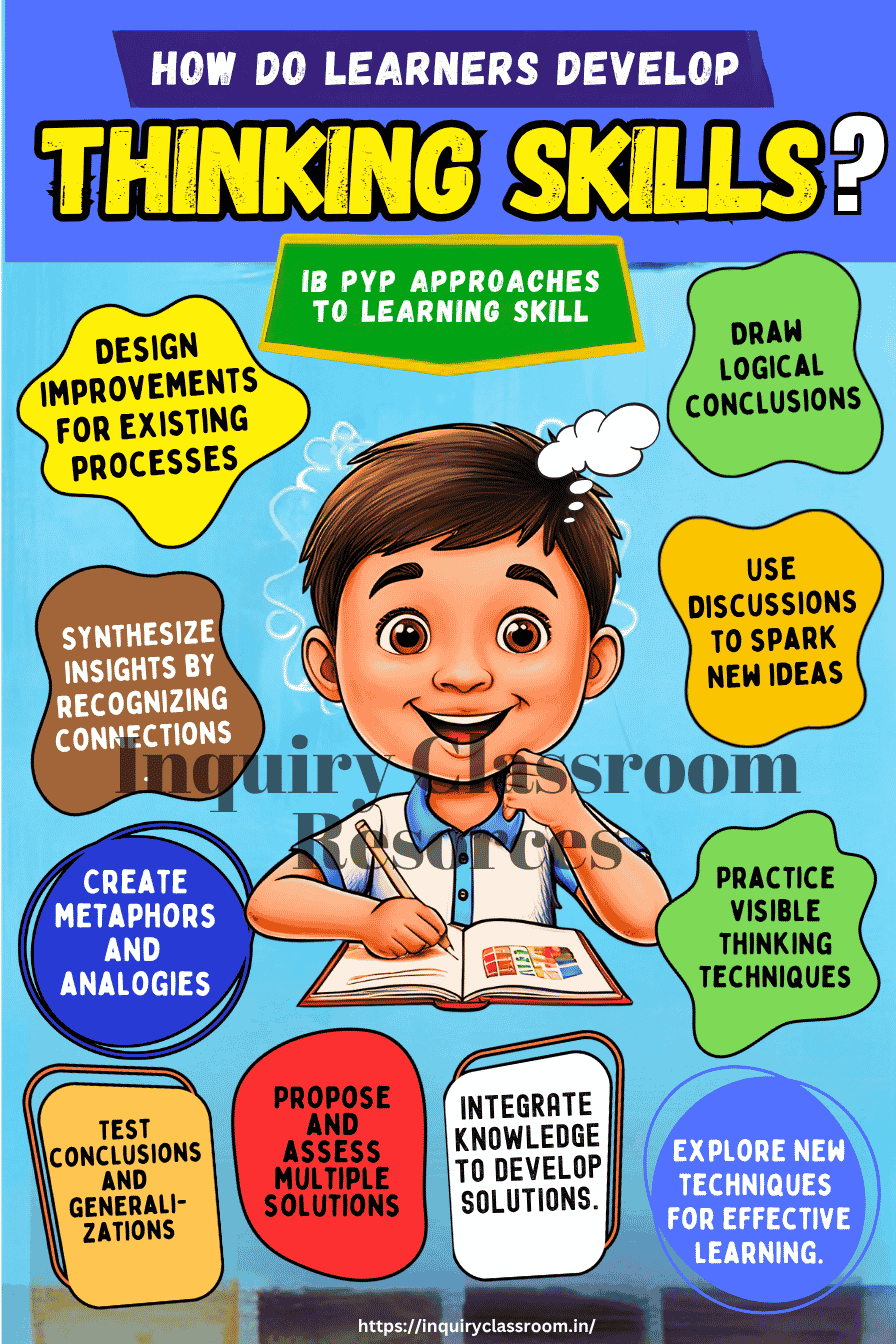 trategies:
- Critical Thinking Activities: Use open-ended questions and scenarios that require students to think critically and justify their responses.
- Creative Thinking Projects: Encourage students to brainstorm and develop creative solutions to real-world problems.
- Visible Thinking Routines: Use routines that make students’ reasoning, assumptions, connections and reflections visible.
- Reflection Prompts: Ask learners to explain not just what they learned, but how they arrived at their understanding.
PYP Unit Example (Grade 5): In a unit about environmental sustainability, learners analyse evidence about plastic waste, generate possible solutions, transfer learning about human impact to a local context, and reflect on which solution is most appropriate and why.
Planning Prompt: “What kind of thinking does this inquiry actually require from learners?”
2. Communication Skills
Definition: Communication skills encompass the ability to express ideas clearly and effectively, both verbally and in writing, as well as active listening and collaboration.
Importance: Effective communication is essential for sharing knowledge, collaborating with peers, and engaging in meaningful discussions.
| Sub-skill | What it can involve | Observable learner behaviour |
|---|---|---|
| Listening | Listening attentively, identifying key ideas, interpreting meaning and responding appropriately | I can listen for key information and respond to what another person has said. |
| Speaking | Expressing ideas, questions, explanations and opinions clearly for a specific purpose and audience | I can explain my thinking clearly and adapt what I say for my audience. |
| Reading | Using reading strategies to locate, interpret, compare and understand information | I can identify important information and explain what I understand from a text. |
| Writing | Using written language to record, organize and communicate ideas for different purposes and audiences | I can organize my ideas and choose language appropriate for my purpose. |
Implementation Strategies: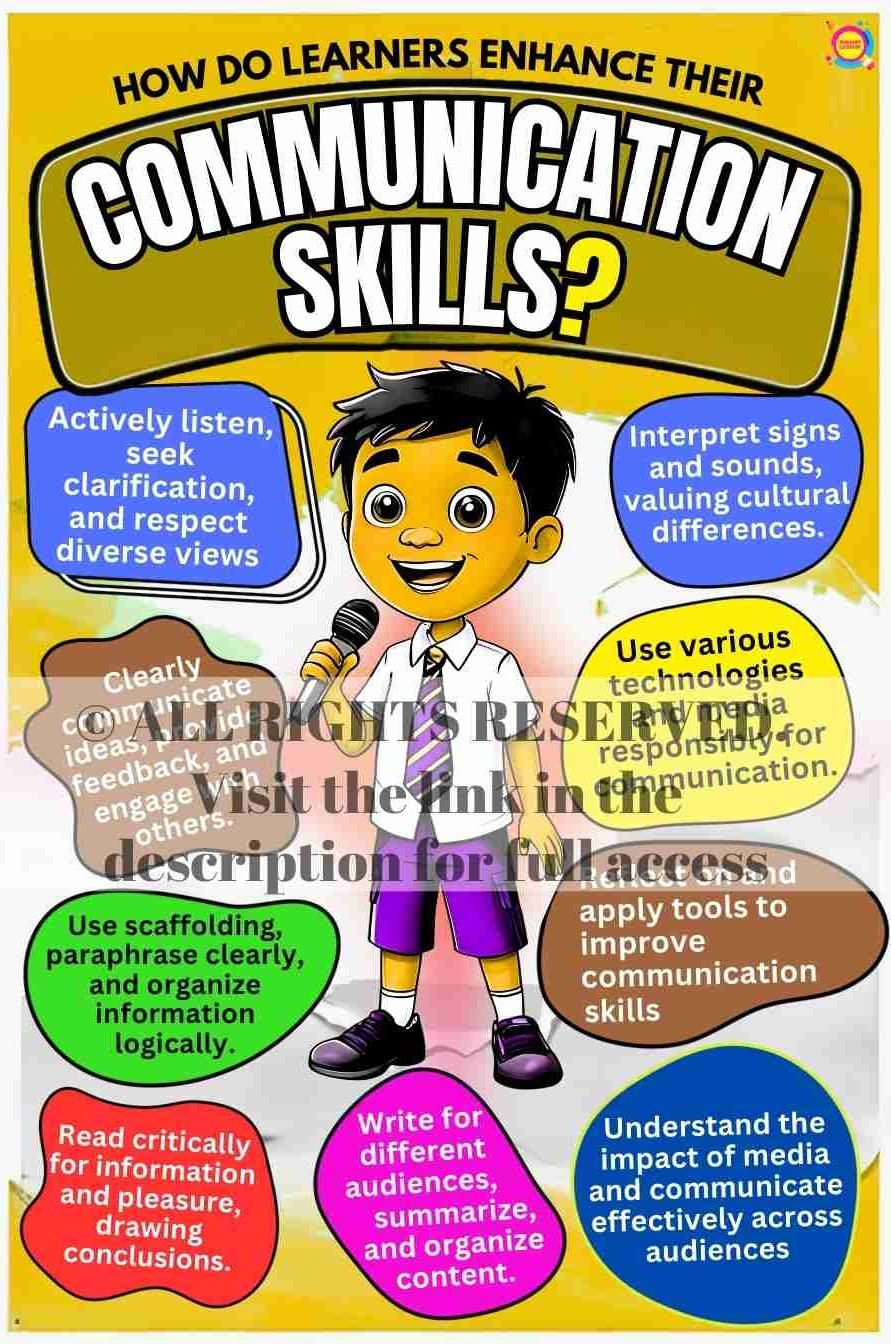
- Classroom Discussions: Facilitate regular group discussions and debates on meaningful topics.
- Presentation Skills: Assign projects that require students to present findings to an authentic audience.
- Reading-to-Inquire Tasks: Ask learners to read, interpret, compare and use information to answer inquiry questions.
- Writing for Purpose: Provide opportunities to write explanations, reflections, arguments, reports and creative responses.
PYP Unit Example (Grade 2): In an inquiry into “How We Express Ourselves,” learners listen to a story read aloud, discuss what the character might be feeling, and write or draw a short response sharing their own perspective with a partner.
Planning Prompt: “How will learners need to communicate their thinking, and who is the audience?
3. Social Skills
Definition: Social skills involve interacting effectively with others, building relationships, and understanding diverse perspectives.
Importance: These skills help students work collaboratively, develop empathy, and build positive interpersonal relationships.
| Sub-skill | What it can involve | Observable learner behaviour |
|---|---|---|
| Collaboration | Working with others, sharing responsibilities, taking group roles, contributing to a common goal | I can contribute to a group task and help the group move towards its goal. |
| Relationships and empathy | Respecting others, listening closely to different perspectives, showing care and considering how others may feel | I can listen to another perspective and respond respectfully. |
| Conflict resolution | Managing disagreement constructively, identifying the issue, working towards a fair or workable solution | I can use respectful strategies to resolve a disagreement. |
| Social-emotional awareness | Recognizing emotions in oneself and others, understanding how behaviour affects a group | I can identify how my actions or emotions may affect others. |
Implementation Strategies: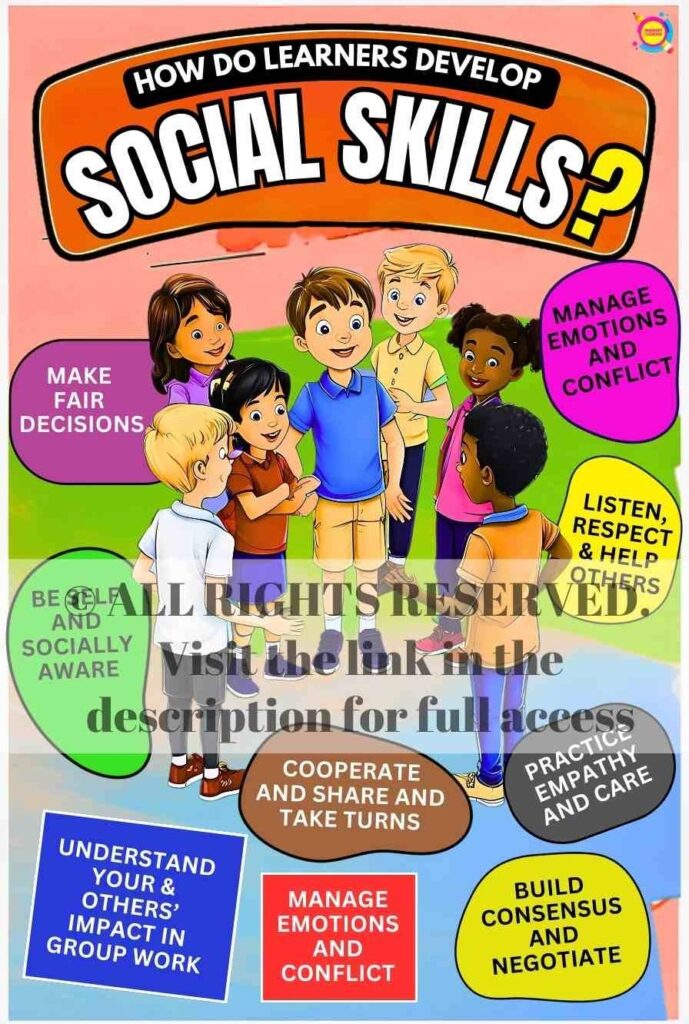
- Group Projects: Encourage teamwork through collaborative projects and group assignments.
- Role-Playing Activities: Use role-play to explore empathy, different perspectives and conflict resolution.
- Structured Collaboration: Give learners clear roles, shared goals and opportunities to reflect on group processes.
- Peer Support: Create opportunities for students to support, coach and give feedback to one another.
PYP Unit Example (Grade 4): During a unit exploring communities, learners work in teams to investigate different community needs, take on different roles, negotiate priorities, and explain how different perspectives influence decisions.
Planning Prompt: “What will learners need to do with and for one another during this inquiry?”
4. Self-Management Skills
Definition: Self-management skills include organization, time management, goal-setting, and the ability to regulate emotions and behaviors.
Importance: These skills are essential for students to manage their learning processes, stay organized, and handle challenges effectively.
| Sub-skill | What it can involve | Observable learner behaviour |
|---|---|---|
| Organization | Managing materials, information, tasks and learning records using an appropriate system | I can organize my materials and learning so I can find and use them when needed. |
| Time and task management | Planning time, prioritizing tasks, monitoring progress, completing work on time | I can break a task into steps and manage my time to meet a deadline. |
| Emotional management | Recognizing emotions and using appropriate strategies to regulate responses and stay ready to learn | I can identify what I am feeling and choose a strategy that helps me continue learning. |
| Mindfulness and focus | Using strategies to manage distractions and maintain attention and awareness | I can identify a distraction and use a strategy to refocus. |
Implementation Strategies: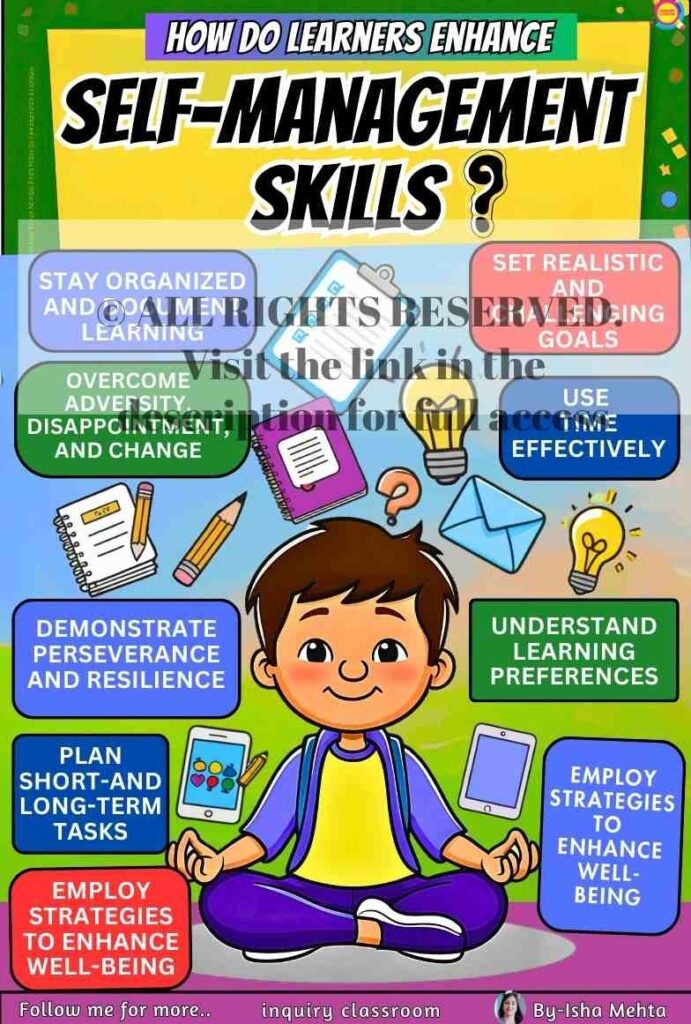
- Goal-Setting Workshops: Guide students in setting and tracking their academic and personal goals.
- Time Management Tools: Provide planners, checklists and schedules to help students manage their time efficiently.
- Learning Organization Systems: Teach learners how to organize notes, resources, and evidence of learning.
- Mindfulness Practices: Incorporate age-appropriate strategies that support focus and awareness.
PYP Unit Example (Grade 1): During a unit on daily routines, learners use a visual checklist to pack their own bag, follow a simple breathing exercise before a task that feels tricky, and talk about which step they found hardest.
Planning Prompt: “What will learners need to manage independently in order to be successful?”
5. Research Skills
Definition: Research skills involve the ability to locate, evaluate, and use information effectively for various purposes.
Importance: ATL skills enable students to conduct independent inquiries, enhance their understanding, and develop a love for learning.
| Sub-skill | What it can involve | Observable learner behaviour |
|---|---|---|
| Formulating questions | Developing relevant questions that guide an investigation and deepen inquiry | I can create questions that help me investigate what I want to understand. |
| Collecting information | Gathering information through observation, interviews, texts, media, surveys or experiments | I can collect information from more than one appropriate source or method. |
| Organizing information | Sorting, recording, categorizing and representing information so patterns become visible | I can organize my information in a way that helps me identify patterns. |
| Evaluating information and sources | Considering relevance, reliability, evidence, perspective and purpose when using information | I can explain why a source is useful or trustworthy for my inquiry. |
| Using information ethically | Acknowledging sources, respecting intellectual property and using information responsibly | I can acknowledge where my information came from. |
Implementation Strategies: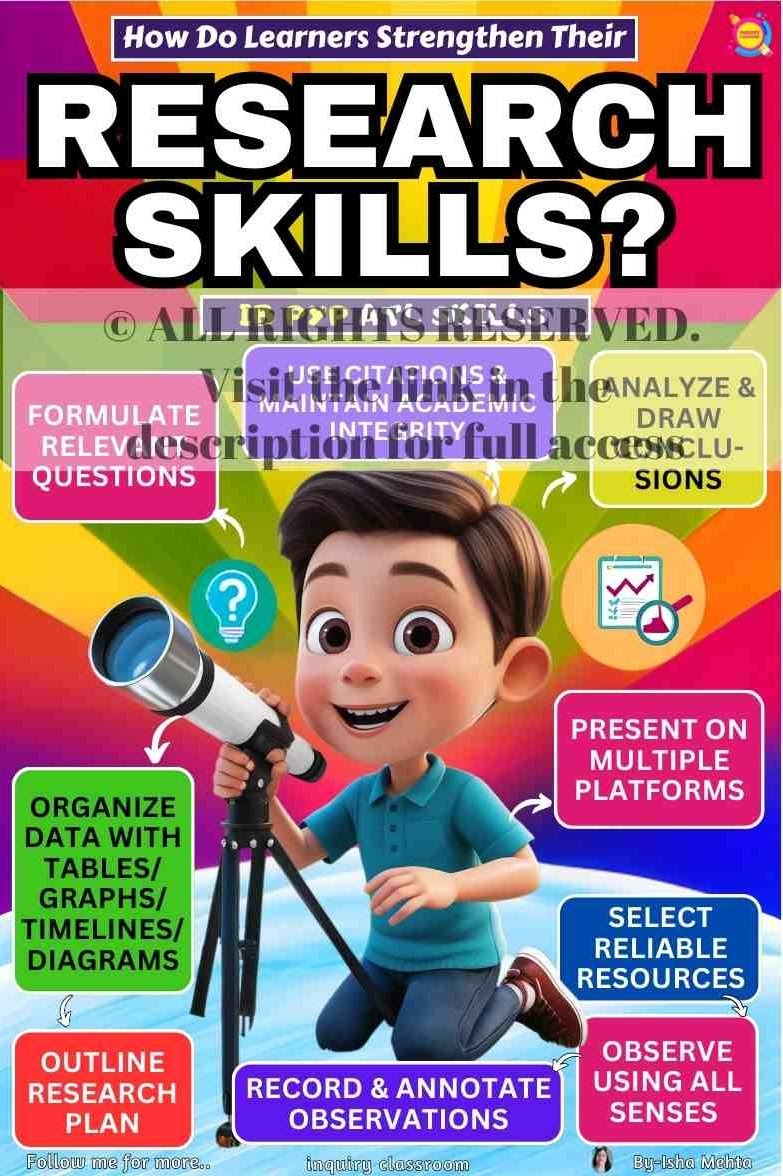
- Information Literacy Lessons: Teach students how to find, compare and evaluate credible sources of information.
- Inquiry-Based Projects: Design projects that require students to formulate questions, conduct research and present findings.
- Source Comparison: Give learners two or more sources and ask them to compare purpose, evidence, perspective and reliability.
- Documentation and Citation: Instruct students on age-appropriate documentation and citation practices.
PYP Unit Example (Grade 3): In a unit on water, learners formulate questions, collect data from two sources, organize their findings on a simple chart, and share one conclusion with the class.
Planning Prompt: “What information will learners need to find, evaluate, organize and use?”
Definition: Research skills involve the ability to locate, evaluate, and use information effectively for various purposes.
Importance: ATL Skills enable students to conduct independent inquiries, enhance their understanding, and develop a love for learning.
Transdisciplinary Learning: Bringing ATL Skills Together
The PYP framework emphasizes transdisciplinary learning, where ATL skills are integrated across various subject areas and learning experiences. This approach helps students make connections between different areas of knowledge and apply their skills in diverse contexts.
Example: A unit on environmental sustainability can integrate research skills (gathering data on pollution), thinking skills (analysing the impact of human activities), and communication skills (presenting findings to the class). Social skills develop through collaborative decision-making, while self-management skills support learners in planning, organizing and monitoring an action project.
How to Select ATL Skills for a PYP Unit
ATL planning becomes more meaningful when teachers don’t simply list all five categories on a planner. Instead, identify the skills learners genuinely need in order to access the inquiry, develop understanding, communicate learning, and take action.
| Planning step | What the teacher considers |
|---|---|
| 1. Start with the learning goal | What do learners need to understand, explore or be able to do? |
| 2. Identify the inquiry demands | Will learners need to question, research, analyse, collaborate, communicate, organize, persevere or reflect? |
| 3. Select 2–4 priority ATL skills | Choose the skills most important for this specific learning experience, rather than trying to teach everything at once. |
| 4. Identify specific sub-skills | Move from a broad category to an observable skill. Example: Research → evaluating information → determining whether a source is reliable. |
| 5. Plan explicit opportunities | Design learning engagements where the skill is intentionally taught, modelled, practised and revisited. |
| 6. Make the skill visible | Write a learning intention and success criteria that make the skill understandable to learners. |
| 7. Assess and reflect | Collect evidence of how learners used the skill and give them opportunities to reflect on strategies, progress and next steps. |
Worked example — Research → Evaluating Information (Grade 5):
Learning intention: We are learning to evaluate the reliability of information sources.
Success criteria:
-
-
- I can identify where information comes from.
- I can identify evidence that supports a source’s reliability.
- I can explain why I chose one source over another.
-
Turning an ATL Skill into a Learning Outcome
A skill that isn’t written as a success criterion is not teachable or assessable. Here’s the same conversion applied across all five categories:
| Category → sub-skill | Weak (skill named only) | Strong (success criterion) |
|---|---|---|
| Thinking — critical thinking | Students will think critically | I can identify at least one piece of evidence and explain why it supports or challenges an idea. |
| Communication — writing | Students will improve their writing | I can organize my ideas into a clear beginning, middle and end for my audience. |
| Social — collaboration | Students will work in groups | I can take on an assigned group role and complete my part without teacher prompting. |
| Self-management — time management | Students will manage their time | I can complete each checklist milestone by its set date, adjusting my plan if I fall behind. |
| Research — evaluating information | Students will do research | I can explain why one source is more reliable than another for my inquiry. |
Explicit and Implicit Development of ATL Skills
ATL skills develop through both explicit and implicit opportunities. Explicit development means the teacher intentionally identifies, models, teaches, practises and reflects on a particular skill. Implicit development happens naturally through meaningful learning experiences where learners use skills as part of the inquiry, without a dedicated lesson on that skill.
| Approach | What it looks like | Example |
|---|---|---|
| Explicit | The skill is named, modelled, practised and reflected upon | Teacher models how to evaluate a source and learners practise using a source checklist |
| Implicit | The skill develops naturally through authentic learning | Learners collaborate during a group inquiry and use social and communication skills without a separate lesson on collaboration |
Assessment and Reflection
Regular assessment and reflection are crucial for the development of ATL skills. Educators should use formative assessment to provide feedback and encourage students to reflect on their learning processes. Assess the specific sub-skill you planned for — not a general “ATL grade.”
Ways to gather evidence of ATL development:
-
- Teacher observation during learning engagements
- Student self-assessment and reflection
- Peer feedback
- Learning journals or reflection entries
- Checklists or success criteria
- Work samples showing use of a specific skill
Reflection questions for learners:
-
-
- Which ATL skill did I use today?
- What strategy helped me use this skill?
- What was challenging?
- What would I do differently next time?
- Where else could I use this skill?
-
ATL Skills in Action: Classroom Examples
Example 1 — Developing Thinking Skills (Grade 5): Design a project where students create a solution for reducing plastic waste in their community.
- Critical Thinking: Students analyse the sources and impact of plastic waste.
- Creative Thinking: Students brainstorm innovative ways to reduce plastic usage.
- Reflection: Students explain which strategy helped them develop their solution.
Example 2 — Enhancing Communication Skills (Grade 3): Organize a class debate on a current event topic.
- Verbal Communication: Students articulate their viewpoints and arguments.
- Active Listening: Students listen to opposing views and respond thoughtfully.
- Collaboration: Students work in teams to prepare their arguments.
Example 3 — Integrating Multiple ATL Skills (Grade 4/5): An inquiry into how communities respond to environmental challenges. Learners formulate research questions, evaluate sources, collaborate to identify possible responses, manage a project timeline, and present recommendations to an authentic audience.
| Learning experience | ATL focus | Possible evidence |
|---|---|---|
| Researching the issue | Research + Thinking | Questions, source evaluation, organized notes |
| Working in teams | Social + Communication | Group roles, discussion, peer feedback |
| Managing the project | Self-management + Thinking | Timeline, task tracking, persistence through setbacks |
| Presenting recommendations | Communication | Presentation, explanation, audience response |
Progression of ATL Skills Across the PYP
ATL skills don’t appear fully formed by Grade 5 — they build year on year. Planning the same sub-skill at every grade band, with rising independence, is what makes a vertically aligned PYP programme rather than five disconnected grade levels.
| ATL Category | Early Years (PreK–Gr1) | Lower Primary (Gr2–3) | Upper Primary (Gr4–5) |
|---|---|---|---|
| Thinking | Sorting, simple comparisons | Identifying cause and effect, basic evaluation | Analysing evidence and bias, generating original solutions |
| Communication | Turn-taking, basic expression | Structured group talk, guided writing | Leading discussion, persuasive and reflective writing |
| Social | Sharing, parallel play moving into cooperation | Group roles with support | Independent role rotation, conflict resolution |
| Self-Management | Visual routines, adult-supported | Checklists with prompts | Independent planning, self-initiated reflection |
| Research | Guided observation | Simple surveys, one or two sources | Multi-source research, evaluating reliability, citation |
A Simple ATL Planning Template for Teachers
Use this structure when planning a unit. The goal is not to list every ATL skill, but to identify the skills that are purposeful and observable within the learning experience.
| Unit / Inquiry | ATL Category | Specific Sub-Skill | Learning Opportunity | Evidence / Reflection |
|---|---|---|---|---|
Planning reminder: a strong ATL plan answers three questions — What skill are learners developing? Where will they practise it? What evidence will show the skill is developing?
Conclusion
The development of ATL skills is essential for fostering independent, lifelong learners who can thrive in a rapidly changing world. By integrating these skills into the PYP framework – down to the specific sub-skill, not just the category name – educators create a holistic, engaging learning environment that prepares students for future success.
Most importantly, ATL planning becomes more powerful when teachers move beyond simply naming a skill. Identify the specific sub-skill, create an authentic opportunity to practise it, make the learning intention visible, gather evidence, and give learners time to reflect on how their skill is developing.
Explore More Resources and Learning Opportunities
If you want to have these colorful and vibrant ATL posters in your classroom, visit the link:
ATL Posters Purchase Link:
Sources and Further Reading
-
- International Baccalaureate Organization. Learning and Teaching — Primary Years Programme. Confirms the five ATL skill categories and explains how ATL skills and associated sub-skills support students in becoming agentic and self-regulated learners through implicit and explicit opportunities. org/programmes/primary-years-programme/curriculum/learning-and-teaching
- International Baccalaureate Organization. Personal inquiries in the PYP: Supporting PYP educators. Provides examples and prompts related to Thinking and Research ATL skills and sub-skills. ibo.org/sharingpyp
- International Baccalaureate Organization. What is an IB education? Explains the five ATL skill categories and their role in developing self-regulated learners across IB programmes. What is an IB education?
Practical reference note: This article is a practical planning guide for PYP educators, built on the IB PYP Approaches to Learning framework and the IB sources linked above. The specific sub-skill lists, “I Can” statements and classroom examples are Inquiry Classroom’s own planning reference – organized to be usable at the unit-planning level and should not be read as a verbatim reproduction of an official IB sub-skill matrix. Always cross-check against your school’s current PYP coordinator resources before formal reporting use.